2) Place downloaded file tcpreplay_4.3.2-1build1_amd64.deb to your KATA node. For example, use scp: [user@host]$ scp <your-path>/tcpreplay_4.3.2-1build1_amd64.deb admin@<kata-ip>:/tmp
3) Run installation on your KATA node with the next command: [admin@katahost]$ sudo dpkg -i /tmp/tcpreplay_4.3.2-1build1_amd64.deb
Success! Now you can use tcpreplay on your KATA 5.+ or any other UBUNTU system!
Before using tcpreplay you should enable tx capture for span:
KATA 3.7.*
In technical support mode from user root run following commands :
systemctl stop apt-preprocessor.service
systemctl stop suricata.service
rmmod pf_ring
Edit file /etc/modprobe.d/pf_ring.conf:
change line: options pf_ring enable_tx_capture=0 min_num_slots=16384 # tx capture is disabled to: options pf_ring enable_tx_capture=1 min_num_slots=16384 # tx capture is enabled save file.
Start pfring and related services back:
modprobe pf_ring
systemctl start suricata.service
systemctl start apt-preprocessor.service
KATA 4.0/4.1
Edit file /etc/modprobe.d/pf_ring.conf:
change line: options pf_ring enable_tx_capture=0 min_num_slots=16384 # tx capture is disabled to: options pf_ring enable_tx_capture=1 min_num_slots=16384 # tx capture is enabled save file.
In technical support mode from user root run following commands:
Email - send the EICAR via SMTP to KATA 25 port. (SMTP processing needs to be Enabled of course). ProTip: you may use local swaks mail client on CN to skip elaborate mail setups.
The rule will mark any analyzed object containing $my_text_string or $my_hex_string.
TAA detects
To check IoA detect (IoA detects can be checked only if you have KEDR license):
Copy .bat file from attached archive Test_IOA.rar(not_infected) to any folder on host with installed EDR and start it. After some time(KATA need several minutes to transmit and process telemetry from EDR) check alerts in KATA. Alert should have type ioa_test_detect.
For testing IoA detects on host more than once, .bat file should be placed to different locations on this host.
On the host with installed KEA run command below in the cmd.exe shell:
wmic.exe sfdguninstallkasperskyblabla
There can be something else instead of sdfg and blabla, important part of command is uninstallkaspersky
Command execution will fail with error, but it's not important. After some time new IoA detect should appear in KATA web-interface.
TAA detects on chain of events (6.1+)
To check TAA detections on chain of events, fist ensure the feature is enabled in KATA Web UI (and also, that customer's sizing allows this feature to be enabled).
Then, on one of connected EDR hosts, unpack these archives and run .bat scripts:
One can use the custom rule for testing - Ioctest.zip (infected123) - it is triggered for "c:\windows\system32\calc.exe"
Automatic sandboxing in EDR
To check automatic sandboxing:
Unpack the archive with sample, use default password for samples: autosbtest.zip
NB! Do not change MD5 of the sample.
Run the sample on EDR-protected host and wait for automatic SB detect:
For KESL:
You can use files from attach to raise alert in KATA with Sandbox and KESL
Unpack archive test_ioa_sb_linux.7z (password: "infected") and copy script "test_ioa_sb_linux.sh" with file "kl_kata_demo_starter" to host with KESL (use WinSCP or etc.).
Check permissions for files: if it not executable, use command "sudo chmod 777 <file>".
Run script using command "./test_ioa_sb_linux.sh" and wait to raise alert in KATA.
Sandbox detect
To check sandbox detect we can use file SA_sleep.exe from archive no_am_detection sample.rar. Password is inside text document in archive.
Go to KATA senior security officer web-interface.
Choose Storage → Upload and upload SA_sleep.exe from attached archive for KATA checking.
Kata should enqueue it to sandbox , then a bit later verdict from SB should be Suspicious Activity.
If SA_sleep.exe produces Not detected verdict then please use test_sb.bat from the test_sb.zip
URL reputation
Firstly, confirm K(P)SN is configured and works properly. MD5 used in this example should return UnTrusted status:
Advice and Solutions (Forum Knowledgebase) Disclaimer. Read before using materials.
Problem
Sometimes it's necessary to check KATA detects, for example IDS, IOA, Sandbox detects.
Step-by-step guide
IDS detects (SPAN)
To check IDS detects (SPAN) you can use tcpreplay utility on server configured to receive SPAN traffic.
KATA 4.0/4.1
tcpreplay package for such versions could be found here https://rhel.pkgs.org/7/epel-x86_64/tcpreplay-4.4.4-1.el7.x86_64.rpm.html
KATA 5.+/6.+ and tcpreplay
tcpreplay package is not installed by default, so you should install it manually, using step-by-step guide below:
1) Download this package from HERE
2) Place downloaded file tcpreplay_4.3.2-1build1_amd64.deb to your KATA node. For example, use scp: [user@host]$ scp <your-path>/tcpreplay_4.3.2-1build1_amd64.deb admin@<kata-ip>:/tmp
3) Run installation on your KATA node with the next command: [admin@katahost]$ sudo dpkg -i /tmp/tcpreplay_4.3.2-1build1_amd64.deb
Success! Now you can use tcpreplay on your KATA 5.+ or any other UBUNTU system!
Before using tcpreplay you should enable tx capture for span:
KATA 3.7.*
In technical support mode from user root run following commands :
systemctl stop apt-preprocessor.servicesystemctl stop suricata.servicermmod pf_ringEdit file
/etc/modprobe.d/pf_ring.conf:change line:
options pf_ring enable_tx_capture=0 min_num_slots=16384 # tx capture is disabled
to:
options pf_ring enable_tx_capture=1 min_num_slots=16384 # tx capture is enabled
save file.
Start pfring and related services back:
modprobe pf_ringsystemctl start suricata.servicesystemctl start apt-preprocessor.serviceKATA 4.0/4.1
Edit file /etc/modprobe.d/pf_ring.conf:
change line:
options pf_ring enable_tx_capture=0 min_num_slots=16384 # tx capture is disabled
to:
options pf_ring enable_tx_capture=1 min_num_slots=16384 # tx capture is enabled
save file.
In technical support mode from user root run following commands:
systemctl stop dockerrmmod pf_ringmodprobe pf_ringsystemctl start dockertx capture for span is now enabled
KATA 5.0/5.1/6.0 - see https://forum.kaspersky.com/topic/how-to-enable-tx-capturing-in-kata-katakedre-37514/
Eicar traffic detect:
Upload
EICAR-Test-File_TCP.pcapsample to server with SPAN interface, then execute command from root shell:tcpreplay -i ens34 EICAR-Test-File_TCP.pcap # ens34 in thisexample is SPAN interfaceNmap traffic detect:
Scenario is the same as for Eicar detect, only
.pcapfile differs (# tcpreplay HackTool.Nmap.HTTP.C&C.pcap).After testing detects from span we strongly recommend to disable tx capture back again by the same way as described above for enabling.
AM Engine
Use EICAR's - https://www.eicar.com/
Email - send the EICAR via SMTP to KATA 25 port. (SMTP processing needs to be Enabled of course). ProTip: you may use local swaks mail client on CN to skip elaborate mail setups.
swaks examples
swaks --server 127.0.0.1--port 25--from *****@*****.tld --to *****@*****.tld --attach eicar.comswaks --server 127.0.0.1--port 25--from *****@*****.tld --to *****@*****.tld --body "link_to_EICAR_here"Endpoint - put an EICAR file to the endpoint and fetch it using GetFile task, queue for scanning.
YARA detects
By default, no YARA rules are supplied with the product. For test purposes one can use a test rule from YARA docs https://yara.readthedocs.io/en/v4.1.0/writingrules.html
rule ExampleRule{strings:$my_text_string= "text here"$my_hex_string= { E2 34 A1 C8 23 FB }condition:$my_text_stringor $my_hex_string}The rule will mark any analyzed object containing $my_text_string or $my_hex_string.
TAA detects
To check IoA detect (IoA detects can be checked only if you have KEDR license):
Copy
.batfile from attached archiveTest_IOA.rar(not_infected) to any folder on host with installed EDR and start it.After some time(KATA need several minutes to transmit and process telemetry from EDR) check alerts in KATA. Alert should have type ioa_test_detect.
For testing IoA detects on host more than once,
.batfile should be placed to different locations on this host.On the host with installed KEA run command below in the
cmd.exeshell:wmic.exe sfdguninstallkasperskyblablaThere can be something else instead of sdfg and blabla, important part of command is uninstallkaspersky
Command execution will fail with error, but it's not important. After some time new IoA detect should appear in KATA web-interface.
TAA detects on chain of events (6.1+)
To check TAA detections on chain of events, fist ensure the feature is enabled in KATA Web UI (and also, that customer's sizing allows this feature to be enabled).
Then, on one of connected EDR hosts, unpack these archives and run .bat scripts:
short_term_user_creation_complex.7z
multiple_login_attempts_with_the_same_account_complex.7z
IoC detects
One can use the custom rule for testing - Ioctest.zip (infected123) - it is triggered for "c:\windows\system32\calc.exe"
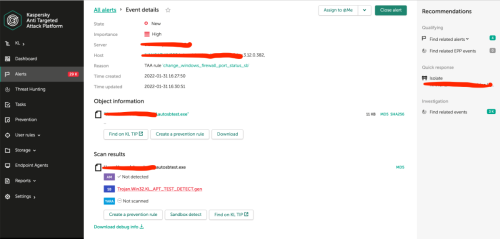
Automatic sandboxing in EDR
To check automatic sandboxing:
Unpack the archive with sample, use default password for samples: autosbtest.zip
NB! Do not change MD5 of the sample.
Run the sample on EDR-protected host and wait for automatic SB detect:
For KESL:
You can use files from attach to raise alert in KATA with Sandbox and KESL
Unpack archive test_ioa_sb_linux.7z (password: "infected") and copy script "test_ioa_sb_linux.sh" with file "kl_kata_demo_starter" to host with KESL (use WinSCP or etc.).
Check permissions for files: if it not executable, use command "sudo chmod 777 <file>".
Run script using command "./test_ioa_sb_linux.sh" and wait to raise alert in KATA.
Sandbox detect
To check sandbox detect we can use file
SA_sleep.exefrom archiveno_am_detection sample.rar.Password is inside text document in archive.Go to KATA senior security officer web-interface.
Choose Storage → Upload and upload
SA_sleep.exefrom attached archive for KATA checking.Kata should enqueue it to sandbox , then a bit later verdict from SB should be Suspicious Activity.
If
SA_sleep.exeproduces Not detected verdict then please use test_sb.bat from the test_sb.zipURL reputation
Firstly, confirm K(P)SN is configured and works properly. MD5 used in this example should return UnTrusted status:
Check KSN on KATA command
for KATA 4.+ and 5.0:docker exec -it `docker ps | grep ksn_proxy| awk '{print $1}'` /opt/kaspersky/apt-ksn_proxy/sbin/ksn_client --ip 127.0.0.1 --hash 9C642C5B111EE85A6BCCFFC7AF896A51for KATA 5.1:docker exec -it $(docker ps | grep ksn_proxy| awk '{print $1}') /opt/kaspersky/apt-ksn-proxy/sbin/ksn_client --ip 127.0.0.1 --hash 9C642C5B111EE85A6BCCFFC7AF896A51Secondly,
For traffic: access http://bug.qainfo.ru/TesT/Aphish_w/index
For email (SMTP processing needs to be Enabled), send the link above via e-mail. For quick and dirty test:
swaks examples
swaks --server 127.0.0.1--port 25--from *****@*****.tld --to *****@*****.tld --body "http://bug.qainfo.ru/TesT/Aphish_w/index"